Wednesday, October 9, 2013
Tuesday, October 8, 2013
PHYSICS - SIMPLE MACHINES - II
Lever


.jpg)


The faucet has threads to screw the hose on.
Some screws have a flat end. We call these screws bolts. Most bolts use a nut.

Many bottles and jars have screw on lids.

Bicycle tires have threads on the stem to screw the cap on.
Light bulbs have threads to screw them into sockets.

A lever is a simple machine made with a straight bar that moves on a fixed point called a fulcrum. All levers have two parts, the bar and the fulcrum. The longer the lever is, the less force will be needed to move the load.
The load and the force move in opposite directions. Notice that as the hammer is pulled down, the nail moves up.
| Examples of Levers | ||
 The tab is a lever used to The tab is a lever used toopen the can. |  The screwdriver is being The screwdriver is beingused as a lever. |  The handle on the pump is The handle on the pump isa lever. |
 The can opener is a lever. The can opener is a lever. |  The bottle opener is a lever. The bottle opener is a lever. |  The shovel is a lever. The shovel is a lever. |
Wheel and Axle
A wheel and axle is made from a wheel that turns on a center post. The larger the wheel is, the less force will be needed to move the load. There are two parts to this simple machine, the wheel and the center post called the axle.
The force moves in the same direction as the load. Notice that in the picture, the force pushes in the same direction that the skateboard is moving.
| Examples of Wheel and Axles | ||
 Skates use wheel and axles. |  We use a wheel and axle to reel in the fishing line. |  Wheelchairs use wheel and axles. |
 The knob part is the wheel. The axle connects the two knobs. |  The steering wheel is a wheel and the axle goes into the steering column. |  Skateboards use wheel and axles. |
Inclined Plane
Any slanted surface is an inclined plane. A ramp is the most common type. A ramp is higher at one end than at the other. The longer the inclined plane is, the less force will be needed to move the load. The only part of an inclined plane is the slanted surface.
The load and the force move in the same direction. Notice in the picture that the force is pushing the lawn mower in the same direction it is moving.
| Examples of Inclined Planes | |||
 An inclined plane lifts the front of this car. |  A long inclined plane equals the four steps. The ramp goes up, turns and continues. |  A short ramp is needed to equal these two steps. | |
 Inclined planes make our work easier. |  An inclined plane is used to lift this heavy wheelbarrow into this trailer. | ||
Wedge
|
A wedge is made by putting two inclined planes together. They come together to form a V-shape. A wedge may be used to lift or pry apart heavy objects. A wedge can also be used to stop an object from moving. A wedge has only one part.
The force and the load move in different directions. In this picture, as the force moves the ax down, the load (wood) breaks apart and falls to the sides.
|
.jpg)
| Examples of Wedges | ||
 The blade of a knife is a wedge. |  Each blade of the scissors is a wedge. |  The sharp edge of an ax is a wedge. |
The sharp edge of the shovel is a wedge. |  A door stop is a wedge that stops the door from moving. |  A wedge called a chock stops the car from moving. |
Pulley
A pulley is a wheel with a rope around it. The rope fits into the groove on the wheel. The larger the wheel is, the less force will be needed to move the load. There are two parts to a pulley, the wheel and the rope.
The load and the force move in opposite directions. As the rope is pulled down, the flag goes up.

| Examples of Pulleys | ||
 Pulleys are used to open and close curtains and blinds. |  A pulley is used to make this ladder longer. |  A pulley is a grooved wheel with a rope around it. |
 Pulleys are used for exercise, especially in hospitals, to help patients grow stronger. |  Pulleys are used to raise and lower sails on sailboats. |  Pulleys are used to raise and lower flags. |
Screw
A screw is an inclined plane that is wrapped around a center post. The longer the inclined plane is the closer the threads of the screw will be and the less force will be needed to move the load. A screw has two parts, the inclined plane and the center post.
The force and the load move in the same direction. As the force pushes down on the screw, the screw goes down into the wood.

Examples of Screws
Some screws have a sharp point and are mostly used on wood.The faucet has threads to screw the hose on.
Some screws have a flat end. We call these screws bolts. Most bolts use a nut.
Many bottles and jars have screw on lids.
Bicycle tires have threads on the stem to screw the cap on.
Light bulbs have threads to screw them into sockets.

Add 3 or more simple machines in your notes from this module
draw, label & explain. Use color!
DUE: Wednesday 10/3

PHYSICS - WHAT IS PHYSICS? #1
OKAY! Let's start here...
So you're asking, what is PHYSICS?
Everything in the universe has an effect on every other thing.
Physics is a science that relates to all other sciences: Chemistry, Biology, Geology, Astronomy, Meteorology, Engineering, etc. If you can name it, chances are physics is involved.
Everything on Earth, everything in our solar system, everything in our galaxy, and everything in the universe moves and interacts, and forces play a big part in that. Physics studies those FORCES and interactions.
Physicists study those effects.
Let's get started and look inside the physics of motion.
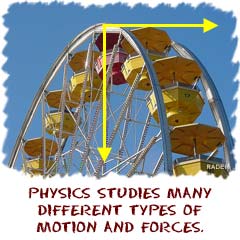 Motion is one of the key topics in physics. Everything in the universe moves. It might only be a small amount of movement and very very slow, but movement does happen. Don't forget that even if you appear to be standing still, the Earth is moving around the Sun, and the Sun is moving around our galaxy. The movement never stops. Motion is one part of what physicists call mechanics. Over the years, scientists have discovered several rules or laws that explain motion and the causes of changes in motion. There are also special laws when you reach the speed of light or when physicists look at very small things like atoms.
Physicists use some basic terms when they look at motion.
 Acceleration is a twist on the idea of velocity.
The first idea is that there are simple movements, such as if you're moving in a straight line, or if two objects are moving towards each other in a straight line. The simplest movement would be objects moving at constant velocity. Slightly more complicated studies would look at objects that speed up or slow down, where forces have to be acting.
There are also more complex movements when an object's direction is changing. These would involve curved movements such as circular motion, or the motion of a ball being thrown through the air. For such complex motions to occur, forces must also be acting, but at angles to the movement.
In order to really understand motion, you have to think about forces, acceleration, energy, work, and mass. These are all a part of mechanics.
So you're asking, what is PHYSICS?
Everything in the universe has an effect on every other thing.
Physics is a science that relates to all other sciences: Chemistry, Biology, Geology, Astronomy, Meteorology, Engineering, etc. If you can name it, chances are physics is involved.
Everything on Earth, everything in our solar system, everything in our galaxy, and everything in the universe moves and interacts, and forces play a big part in that. Physics studies those FORCES and interactions.
Physicists study those effects.
Let's get started and look inside the physics of motion.
Mechanics and Motion
Motion is one of the key topics in physics. Everything in the universe moves. It might only be a small amount of movement and very very slow, but movement does happen. Don't forget that even if you appear to be standing still, the Earth is moving around the Sun, and the Sun is moving around our galaxy. The movement never stops. Motion is one part of what physicists call mechanics. Over the years, scientists have discovered several rules or laws that explain motion and the causes of changes in motion. There are also special laws when you reach the speed of light or when physicists look at very small things like atoms. Speed it Up, Slow it Down
The physics of motion is all about forces. Forces need to act upon an object to get it moving, or to change its motion. Changes in motion won't just happen on their own. So how is all of this motion measured?Physicists use some basic terms when they look at motion.
- How fast an object moves, its speed or Velocity, can be influenced by forces.
- (Note: Even though the terms 'speed' and 'velocity' are often used at the same time, they actually have different meanings.)
Acceleration is a twist on the idea of velocity. - Acceleration is a measure of how much the velocity of an object changes in a certain time (usually in one second).
- Velocities could either increase or decrease over time.
- Mass is another big idea in motion. Mass is the amount of something there is, and is measured in grams (or kilograms).
- A car has a greater mass than a baseball.
Simple and Complex Movement
There are two main ideas when you study mechanics.The first idea is that there are simple movements, such as if you're moving in a straight line, or if two objects are moving towards each other in a straight line. The simplest movement would be objects moving at constant velocity. Slightly more complicated studies would look at objects that speed up or slow down, where forces have to be acting.
There are also more complex movements when an object's direction is changing. These would involve curved movements such as circular motion, or the motion of a ball being thrown through the air. For such complex motions to occur, forces must also be acting, but at angles to the movement.
In order to really understand motion, you have to think about forces, acceleration, energy, work, and mass. These are all a part of mechanics.
Monday, October 7, 2013
PHYSICS - LEVERS
LEVERS
ADD TO NOTES
Lever is one of the simplest mechanical devices.


FIRST-CLASS LEVER


ADD TO NOTES
Lever is one of the simplest mechanical devices.
A lever consists of a beam or stick or rod. However, a lever by itself is not effective. It must have something on which to pivot.
This pivot is called a fulcrum. A lever helps to lift weights with less effort.
- Children on opposite ends of a seesaw lift each other's weight up and down easily.
- Anyone who has ever pried something loose with a crowbar or a board has used a lever.

FIRST-CLASS LEVER
- Fulcrum in the middle
- weight at one end
- force at the other end
SECOND-CLASS LEVER
- Fulcrum at the end
- weight in the middle
- force at the other end
THIRD-CLASS LEVER
- Fulcrum at the end
- weight at the other end
- force in the middle
PHYSICS - FRICTION
FRICTION
When a moving object is touching another object, like a coin sliding across a table the moving object slows down. The force that causes this is called friction.
Friction occurs in liquids & gases as well as between solids. Anything that experience friction warms up.
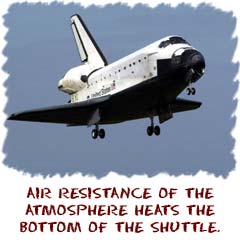 Friction only happens with solid objects, but you do get resistance to motion in both liquids and gases. This doesn't involve sliding surfaces like friction does, but is instead the kind of resistance you get if you try to push your way through a crowd. It's a colliding situation, not a sliding one. If the gas is air, this is referred to as air resistance.
If you were in the space shuttle and re-entering the atmosphere, the bottom of the shuttle would be getting very hot. The collisions that occur between the molecules of the air being compressed by the shuttle, heat up the air AND the shuttle itself. The temperature on the top of the shuttle is also warm, but nowhere near the temperatures found on the bottom.
 You will find friction everywhere that objects come into contact with each other. The force acts in the opposite direction to the way an object wants to slide. If a car needs to stop at a stop sign, it slows because of the friction between the brakes and the wheels. If you run down the sidewalk and stop quickly, you can stop because of the friction between your shoes and the cement.
USING FRICTION
Friction is useful in some situations & a nuisance in others. If there were no friction between surfaces, it would be impossible to grip anything.
Many kinds of machines make use of friction. With too little friction between tires & the surface of a rod, for example, drivers wouldn't be able to stop their vehicles from sliding around.

 Magnification show how a smoother-seeming metal surface is actually fairly rough. A layer of oil between moving metal surfaces reduces friction.
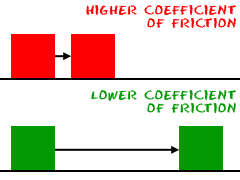 Measures of friction are based on the type of materials that are in contact. Concrete on concrete has a very high coefficient of friction. That coefficient is a measure of how easily one object moves in relationship to another.
Scientists have discovered that there is even less friction in your joints than in Teflon! It is one more example at how efficient living organisms can be.

When a moving object is touching another object, like a coin sliding across a table the moving object slows down. The force that causes this is called friction.
- The rougher the surfaces are, and the harder there will be.
Friction occurs in liquids & gases as well as between solids. Anything that experience friction warms up.
Friction and Gases
Friction only happens with solid objects, but you do get resistance to motion in both liquids and gases. This doesn't involve sliding surfaces like friction does, but is instead the kind of resistance you get if you try to push your way through a crowd. It's a colliding situation, not a sliding one. If the gas is air, this is referred to as air resistance.If you were in the space shuttle and re-entering the atmosphere, the bottom of the shuttle would be getting very hot. The collisions that occur between the molecules of the air being compressed by the shuttle, heat up the air AND the shuttle itself. The temperature on the top of the shuttle is also warm, but nowhere near the temperatures found on the bottom.
Friction and Liquids
Although liquids offer resistance to objects moving through them, they also smooth surfaces and reduce friction. Liquids tend to get thinner (less viscous) as they are heated. Yes, that's like the viscosity of the oil you put in your car.- Car engines have a lot of moving parts, and they rub on each other. The rubbing produces friction and the result is heat. When oil is added to a car engine, the oil sticks to surfaces, and helps to decrease the amount of friction and wear on the parts of the engine. An engine that runs hotter requires a more viscous oil in order for it to stick to the surfaces properly.
 You will find friction everywhere that objects come into contact with each other. The force acts in the opposite direction to the way an object wants to slide. If a car needs to stop at a stop sign, it slows because of the friction between the brakes and the wheels. If you run down the sidewalk and stop quickly, you can stop because of the friction between your shoes and the cement.
 USING FRICTION
Friction is useful in some situations & a nuisance in others. If there were no friction between surfaces, it would be impossible to grip anything.
Many kinds of machines make use of friction. With too little friction between tires & the surface of a rod, for example, drivers wouldn't be able to stop their vehicles from sliding around.

REDUCING FRICTION
Lots of friction between machine parts is damaging. It causes wear & tear, and some of the energy needed to run the machine is wasted on heat instead of movement. Oil is used reduce friction because it is smoother than any solid surface, so it allows objects to slide across each other more easily. A liquid used like this is called a lubricant.
Magnification show how a smoother-seeming metal surface is actually fairly rough. A layer of oil between moving metal surfaces reduces friction.Measuring Friction
Measures of friction are based on the type of materials that are in contact. Concrete on concrete has a very high coefficient of friction. That coefficient is a measure of how easily one object moves in relationship to another. - When you have a high coefficient of friction, you have a lot of friction between the materials. Concrete on concrete has a very high coefficient, and Teflon on most things has a very low coefficient. Teflon is used on surfaces where we don't want things to stick; such as pots and pans.
Scientists have discovered that there is even less friction in your joints than in Teflon! It is one more example at how efficient living organisms can be.
RECAP
Friction is a force that holds back the movement of a sliding object.
You will find friction everywhere that objects come into contact with each other. The force acts in the opposite direction to the way an object wants to slide. If a car needs to stop at a stop sign, it slows because of the friction between the brakes and the wheels. If you run down the sidewalk and stop quickly, you can stop because of the friction between your shoes and the cement.
What happens if you run down the sidewalk and you try to stop on a puddle?
Friction is still there, but the liquid makes the surfaces smoother and the friction a lot less.
- Less friction means it is harder to stop. The low friction thing happens to cars when it rains. That's why there are often so many accidents. Even though the friction of the brakes is still there, the brakes may be wet, and the wheels are not in as much contact with the ground. Cars hydroplane when they go too fast on puddles of water.
Subscribe to:
Posts (Atom)