ELECTRICITY REVIEW ACTIVITY - #1
QUIZ REVIEW - ELECTRICTY #1
- WRITE YOUR NAME
- QUIZ NAME
- SCORE
- ON NOTEBOOK PAPER & TURN IN TO DRAWER


| 2/17/2014 | SCIENCE WORLD (2/3) | READ & TAKE NOTES: p. 5, 6, 8-13, 20-22 | class discussion | 2/21/2014 |

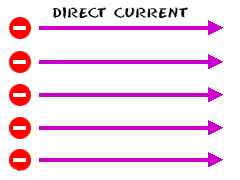 There are two main types of current in our world. One is direct current (DC) which is a constant stream of charges in one direction. The other is alternating current (AC) that is a stream of charges that reverses direction. Let's look at DC power which was refined by Thomas Edison in the 1800s.
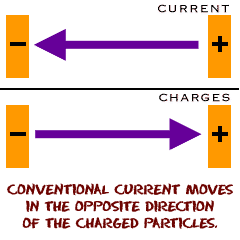 Electrons move from areas where there are excess of negative charges to areas where there are a deficiency (or positive charge). Electrons move from "-" to "+", but conventional current is considered to move in the other direction. When you set up a circuit, conventional current is considered to move from the "+" to the "-" side.
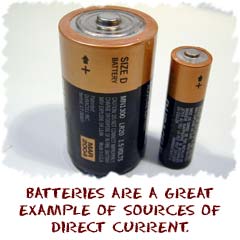 The best real-life example of direct current is a battery. Batteries have positive (+) and negative (-) terminals. If you take a wire and connect the positive and negative terminals on a battery, the electrons in the wires will begin to flow to produce a current. You can prove that the current is flowing if you connect a small light to the circuit. The light will begin to glow as the electrons pass through the filaments.

Magnetised  |


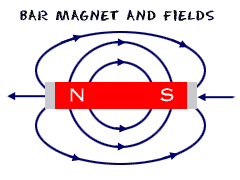 A magnet is an object or a device that gives off an external magnetic field. Basically, it applies a force over a distance on other magnets, electrical currents, beams of charge, circuits, or magnetic materials. Magnetism can even be caused by electrical currents.
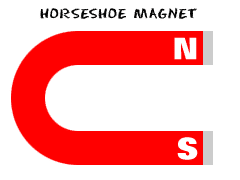 There are many different types of magnets. Permanent magnets never lose their magnetism. There are materials in the world that are called ferromagnetic. Those materials are able to create and hold a specific alignment of their atoms. Since many atoms have a magnetic moment (tiny magnetic field), all of the moments can add up to create a magnet. Scientists use the word hysteresis to describe the way the atoms stay aligned.
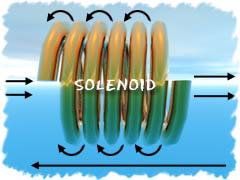 Electromagnets are different because they have a ferromagnetic material (usually iron or steel) located inside of the coils of wire. The core isn't air, it is something that aids in producing magnetic effects, so electromagnets are typically stronger than a comparable air-core magnet. Air-core and electromagnets can be turned on and off. They both depend on currents of electricity to give them magnetic characteristics. Not only can they be turned on and off, but they can also be made much stronger than ordinary magnets. You might see an electromagnet at work in a junkyard lifting old cars off the ground.
 Magnetism is an invisible force or field caused by the unique properties of certain materials. In most objects, electrons spin in different, random directions. This causes them to cancel each other out over time. However, magnets are different. In magnets the molecules are uniquely arranged so that their electrons spin in the same direction. This arrangement of atoms creates two poles in a magnet, a North-seeking pole and a South-seeking pole.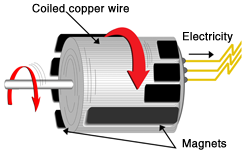
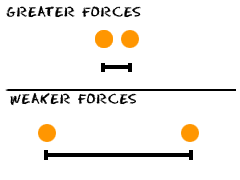 Think about a few concepts before you continue reading. Some charges are attracted to each other. Positive and negative charges like to move towards each other. Similar charges such as two positive or two negative push away from each other. You also need to understand that forces between objects become stronger as they move together and weaker as they move apart. You could yell at someone from far away, and they would barely hear you. If you yelled the same amount when you were together, it would be more powerful and loud.
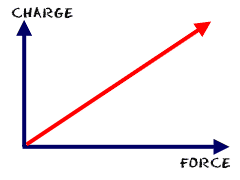 But you're here to learn about the law. When you have two charged particles, an electric force is created. If you have larger charges, the forces will be larger. If you use those two ideas, and add the fact that charges can attract and repel each other you will understand Coulomb's Law. It's a formula that measures the electrical forces between two objects.
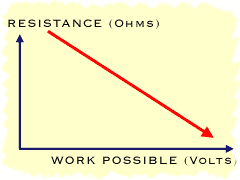 The symbol "V" is used to represent something called the potential difference. Potential difference is the amount of work done in moving a charge between two points, divided by the size of the charge. That's kind of complicated, though. You can think of potential as electrical height. High potential (near positive charge) is kind of like being on top of a hill. Low potential (near negative charge) is kind of like being in a valley. So potential difference indicates the difference in electrical height between two points. The greater that difference, the more likely it is that charge will move. The potential difference is measured in volts, and potential is commonly referred to as voltage. "I" is the symbol for current and "R" is the symbol for the resistance of the system. Current is measured in amperes and resistance is measured in ohms.
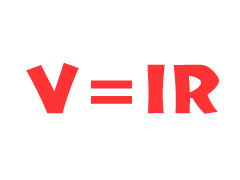 Let's go back to that equation and look at it in terms of resistance. When you move the values around you get R=V/I. In English that means the resistance of a system is based on voltage and current. Not all conductors follow Ohm's law.
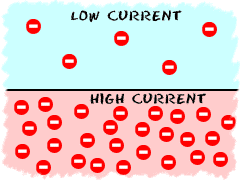 Electric current is very similar to a flowing river. The river flows from one spot to another and the speed it moves is the speed of the current. The size of the current flow is related more to the size of the river than it is to the speed of the river. A river carries more water each second than a stream, even if both flow at the same speed. With electricity, current is a measure of the amount of charge transferred over a period of time. Current is a flow of electrons, or individual negative charges. When charge flows, it carries energy that can be used to do work. Scientists measure current with units called amperes.
 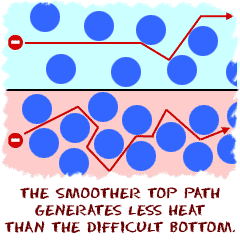 One of the results of current is the heating of the conductor. When an electric stove heats up, it's because of the flow of current. The electrons have a mass (however small), and when they move through the conductor, there are collisions that produce heat. The more electrons bumping into the atoms of the conductor, the more heat is created, so higher current generally means greater heat.
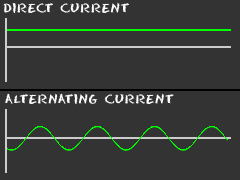 There are two main kinds of electric current, direct current (DC) and alternating current (AC). They are easy to remember. Direct current is a flow of charge always in one direction. Alternating current is a flow of charge back and forth, changing its direction many times in one second. Batteries produce DC current, while the outlets in our homes use AC current.