
Monday, January 13, 2014

Sunday, January 12, 2014
DENSITY TRIANGLE???
The density triangle is a trick that will tell which formula to use in order to find the density, mass, or volume when you have the other two.
The density triangle is a triangle that is split into three sections.
- Density, which is symbolized by the letter "D," is in the left bottom section
- Mass, which is symbolized by the letter "M," is on the top
- Volume, which is symbolized by the letter "V", is on the bottom right.
Write the letters D, M, and V in the triangle in the order that you reach each section as you go from left to right. The diagram below will show you how this is done.
To use the DMV Triangle, after you have set it up, simply cover the item that you want to find and you have to formula!!! Below are a few demonstrations.
Start with the DMV Triangle:

To find the formula for "Density," cover up the "D" (as shown below).
This leaves the the "M" over the "V," giving you the formula "M/V." Therefore, the fomula is D = M/V
To find the formula for "Volume," cover up the "V" (as shown below).
This leaves the the "M" over the "D," giving you the formula "M/D." Therefore, the formula is V = M/D.
To find the formula for "Mass," cover up the "M" (as shown below).
This leaves the the "D" over the "V," giving you the formula "D x V." Therefore, the formula is M = D x V.
Why would we want to use this?
By using this trick, you never have to remember any of the actual formulas. All you have to do is remember "DMV." Since the Department of Motor Vehicles. The trick is knowing where each letter goes, but, once you have that down, each of the formulas can be seen easily, without a chance of error.
Thursday, January 9, 2014
SCIENCE NEWS - STUDENT PROJECT
SCIENCE NEWS
Since the
start of the school year we have done a wide-range of SCIENCE NEWS to help us learn about the happenings in our world
from the incredible people who research, develop, and change our lives with
science.
You will
research, design, & present a SCIENCE
NEWS.
· Topic: must
have current & detailed research on your science topic of your choice.
· Format: must enhance the presentation of facts (video,
brochure, graphics, power point, Glogster, hands-on demonstration, audio, ETC…
· Presentation: must engage & inform your audience. Facts delivered must be clear &
informative
· Time: You will be allowed a maximum of 3 minutes to
present your science news.
Vocabulary terms: you must add all new terms with definitions in your presentation
Vocabulary terms: you must add all new terms with definitions in your presentation
· You must have your topic approved by
me before you begin
· You must sign up for a date for your
presentation
see hand out for further details
see hand out for further details
Tuesday, January 7, 2014
BUOYANCY
Carefully read the buoyancy worksheet, highlight important points; participate in the buoyancy activity; and watch the video.
BUOYANCY ACTIVITY
DENSITY & BUOYANCY
BUOYANCY ACTIVITY
DENSITY & BUOYANCY
Friday, December 27, 2013
HAPPY NEW YEAR 2014

The spirit of the horse is recognized to be the Chinese people's ethos – making unremitting efforts to improve themselves. It is energetic, bright, warm-hearted, intelligent and able. Ancient people liked to designate an able person as 'Qianli Ma', a horse that covers a thousand li a day (one li equals 500 meters).
Thursday, December 12, 2013
DENSITY & BUOYANCY TEST!!!
- Take the test from the link below.
- You may use only notes in your note book
- You can take the test 2 times only!
- Record both test scores on a sheet of papeR
- Titled - DENSITY & BUOYANCY TEST
- DUE: Wednesday, 12/18
- Turn into drawer
Click on this link: DENSITY & BUOYANCY TEST
Wednesday, December 11, 2013
AIR RESISTANCE, GRAVITY, & AIRPLANE FORCES - REVIEW
REVIEW:
REVIEW THE FOLLOWING ACTIVITIES & YOUR NOTES FOR QUIZ ON AIR RESISTANCE & FORCE ON AIRPLANE
QUIZ: Tuesday, 12/17
TYPES OF FORCE #1
TYPES OF FORCE #2
TYPES OF FORCE #3
An airplane flying straight and level at a constant speed has four forces acting on it: lift, drag, weight and thrust. Weight and mass are not the same thing.
Mass is a measure of the amount of matter in an object, while weight factors in the downward pull of gravity on an object.
In light aircraft, piston engines drive propellers. Propellers deflect air backward, and this air pushes back, creating thrust. The same principle applies to jet engines, which blast hot, expanding gases to the rear of the plane and, in turn, get pushed back by those same gases.
The forces acting on a plane work in opposing pairs. Weight opposes lift, drag opposes thrust. During steady, level flight, the pilot adjusts the engine power and various control surfaces to keep the opposing forces in balance.
Birds figured it out long before humans: You gotta have wings if you're going to fly. Wings create lift, the upward-acting force that gets your feet off the ground.
Wing sounds so simple, but airfoil soars with sophistication. Technically speaking, an airfoil is the shape of the wing -- a curved surface with a rounded leading edge and a sharp trailing edge.
Daniel Bernoulli and his famous principle get a lot of attention when it comes to lift. A lot of aviation enthusiasts would argue, however, that Bernoulli is only part of the lift story though.
Move over Bernoulli, Newton wants to fly this plane. According to authors Anderson and Eberhardt, Newton's third law of motion is perfectly capable of explaining how a wing works: Grossly simplified, it says that the wing pushes the air down, so the air pushes the wing up.
On an airfoil, the amount of curvature is determined by the camber line. Airfoils with positive camber -- the upper surface curves more than the lower surface -- generate better lift.
For an airfoil to work, the leading edge of the wing must be inclined upward. The more it's inclined, the greater the angle of attack. Put another way, the angle of attack is the angle between the chord, or midline, of an airfoil and the direction of the surrounding undisturbed flow of gas or liquid.
The angle of attack is related to the amount of lift. Lift will increase as the angle of attack is increased -- up to a point (called the critical angle of attack). For most aircraft, lift will be maximized if the angle of attack remains below 17 degrees.
While it's true that increasing the angle of attack increases lift, it's also true that you can have too much of a good thing. When the angle of attack becomes too steep, the wing can't generate lift, and the aircraft stalls.
Elevators are hinged flaps located on the tail of the plane. Raising the elevators deflects air downward, which pushes the tail down (and the nose up). Lowering the elevators pushes the tail up (and the nose down).
AIR RESISTANCE
GRAVITY
Every object in the Universe attracts every other object in the universe. This invisible force for masses to move toward each other is called Gravity.
When you weight yourself, your weight may be around 30kg to maybe 50kg because of Gravity.
Your weight is the result from the product of the force of gravity and the mass of you.
Why two masses separated in space have a gravitational attraction to one another remains unknown, despite much research and various theories.
Here are some important facts about gravity:
REVIEW THE FOLLOWING ACTIVITIES & YOUR NOTES FOR QUIZ ON AIR RESISTANCE & FORCE ON AIRPLANE
QUIZ: Tuesday, 12/17
TYPES OF FORCE #1
TYPES OF FORCE #2
TYPES OF FORCE #3
An airplane flying straight and level at a constant speed has four forces acting on it: lift, drag, weight and thrust. Weight and mass are not the same thing.
Mass is a measure of the amount of matter in an object, while weight factors in the downward pull of gravity on an object.
In light aircraft, piston engines drive propellers. Propellers deflect air backward, and this air pushes back, creating thrust. The same principle applies to jet engines, which blast hot, expanding gases to the rear of the plane and, in turn, get pushed back by those same gases.
The forces acting on a plane work in opposing pairs. Weight opposes lift, drag opposes thrust. During steady, level flight, the pilot adjusts the engine power and various control surfaces to keep the opposing forces in balance.
Birds figured it out long before humans: You gotta have wings if you're going to fly. Wings create lift, the upward-acting force that gets your feet off the ground.
Wing sounds so simple, but airfoil soars with sophistication. Technically speaking, an airfoil is the shape of the wing -- a curved surface with a rounded leading edge and a sharp trailing edge.
Daniel Bernoulli and his famous principle get a lot of attention when it comes to lift. A lot of aviation enthusiasts would argue, however, that Bernoulli is only part of the lift story though.
Move over Bernoulli, Newton wants to fly this plane. According to authors Anderson and Eberhardt, Newton's third law of motion is perfectly capable of explaining how a wing works: Grossly simplified, it says that the wing pushes the air down, so the air pushes the wing up.
On an airfoil, the amount of curvature is determined by the camber line. Airfoils with positive camber -- the upper surface curves more than the lower surface -- generate better lift.
For an airfoil to work, the leading edge of the wing must be inclined upward. The more it's inclined, the greater the angle of attack. Put another way, the angle of attack is the angle between the chord, or midline, of an airfoil and the direction of the surrounding undisturbed flow of gas or liquid.
The angle of attack is related to the amount of lift. Lift will increase as the angle of attack is increased -- up to a point (called the critical angle of attack). For most aircraft, lift will be maximized if the angle of attack remains below 17 degrees.
While it's true that increasing the angle of attack increases lift, it's also true that you can have too much of a good thing. When the angle of attack becomes too steep, the wing can't generate lift, and the aircraft stalls.
Elevators are hinged flaps located on the tail of the plane. Raising the elevators deflects air downward, which pushes the tail down (and the nose up). Lowering the elevators pushes the tail up (and the nose down).
AIR RESISTANCE
GRAVITY
Every object in the Universe attracts every other object in the universe. This invisible force for masses to move toward each other is called Gravity.
When you weight yourself, your weight may be around 30kg to maybe 50kg because of Gravity.
Your weight is the result from the product of the force of gravity and the mass of you.
Why two masses separated in space have a gravitational attraction to one another remains unknown, despite much research and various theories.
Here are some important facts about gravity:
| Using scientific language | Which translate to... |
| Gravity is the experience of two particles mutually attracting each other along the line joining them. | Imagine yourself deep in space and you are standing next to a brick.When you are running in a marathon, you are running in a particular direction, but gravity has no particular direction, but along the path joining you and that brick. |
| Spherically symmetric objects interact gravitationally as if their mass were located at their centers. | An example of a spherically symmetric object is the Earth. Earth attracts as if it's mass were located at the centre of Earth. |
| It is gravity which causes the centripetal acceleration when a satellite moves in a circular orbit. | Gravity is what allows a satellite to move in a circular orbit around earth. |
| For a particular radius of circular orbit there is only one possible speed for a stable satellite orbit. | If a satellite wants to orbit 2,000km above Earth, there is only one speed at which it can stably orbit. |
HOW MUCH WOULD WEIGHT ELSEWHERE? (click on the link) |
Monday, December 9, 2013
DENSITY & ARCHIMEDES??? - MODULE #3
Could you please explain density?
What is it? What is the concept of D = M over V?
Density
is how much mass a material has for a given volume.
- A measure of the compactness of the molecules of a material. The closer the particle are to one another the higher the density of the material. The mass per unit of volume of a material.
D = m/v
D = density
m = mass
v = volume
Mass = The amount of matter inside an object. It does not change based on gravity. It is usually measured in grams or kgrams.
Volume = the amount of space an object occupies. Usually measured in L, ml, or cm3 using a graduated cylinder.
Think about a
sponge. Most artificial sponges today are made of a foamed plastic.
Assume you have a one pound sponge. If you melt it down to a plastic
soup with all the bubbles gone, it will be much smaller, but it will
still weigh one pound. It is now denser.
We use water as sort of a
standard for density. We say water has a density of 1. If something
weighs twice as much as the same volume of water we say its density is
two.
- This is really handy for figuring out all sorts of things like if something will float or not.
Ice is ~12% less dense than water so ice floats. Water gets bigger when it freezes so ice is less dense than water. It's a good thing too since life probably would not exist if that were not the case. A U.S. air craft carrier weighs more than 200,000,000 pounds, but I know its density is still less than one. I know this without even asking anyone since I have seen them floating.
An object that is very dense is usually very heavy for its size.
- For example, a bowling ball is more dense than a beach ball. Sometimes, the density of an object can change, like when you pack a snowball - the snow starts out light and fluffy and then you compress it to a higher density.
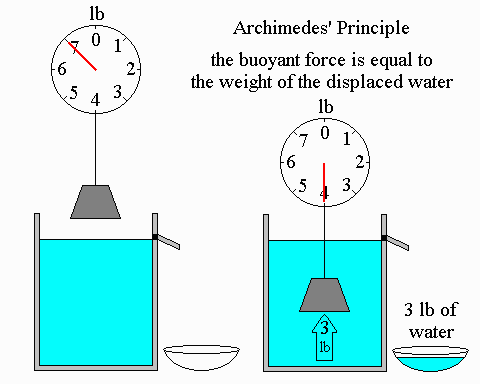
Archimedes' Principle
-
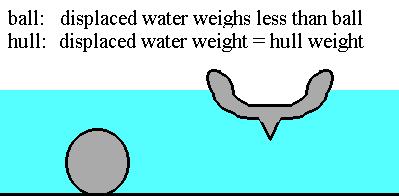
If the weight of the water displaced is less than the weight of the object, the object will sink
-
Otherwise the object will float, with the weight of the water displaced equal to the weight of the object.
Archimedes' Principle explains why steel ships float
AFTER WATCHING THE ARCHIMEDES' PRINCIPLE VIDEO -
- CLICK ON THE "THINK" BUTTON RIGHT COLUMN.
- ANSWER THE QUESTIONS on a piece of notebook paper & turn into the drawer.
Subscribe to:
Posts (Atom)